

Is Our Digital Growth Sustainable? Africa’s E-Waste Problem and What to Do About It- DIID Dialogues.
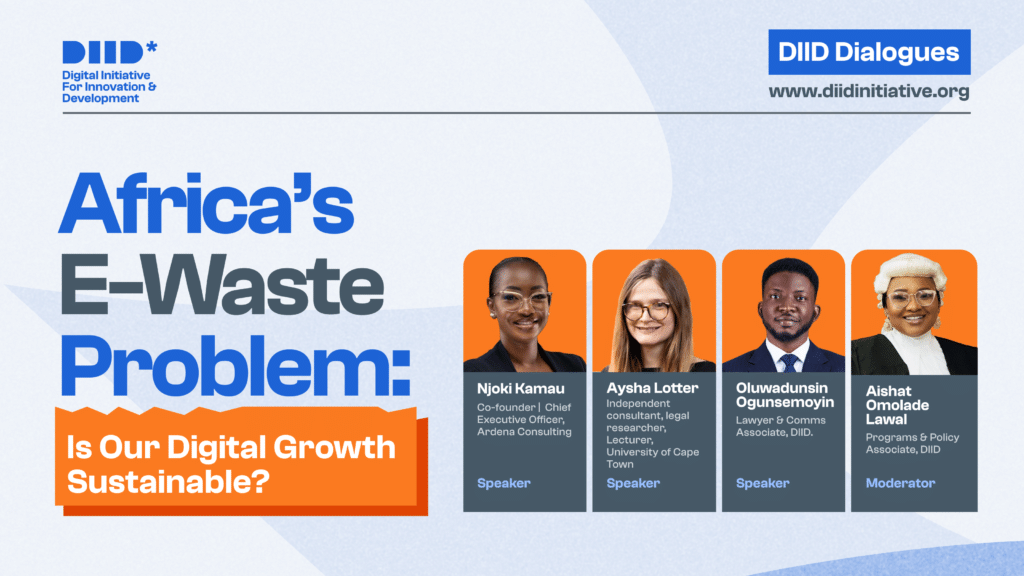
DIID Dialogues | October 2026
Think back to the first phone or laptop you ever owned. Do you know where it ended up after you had stopped using it?
One of the marks of Africa’s growing digital inclusion is the increase in the purchase of gadgets by Africans. But these gadgets have a lifespan. What happens to them when they reach the end of it? Do they become a burden on the environment, or can they be recycled into value?
We discussed this at DIID Dialogues on Friday, October 23, 2026, under the topic: Africa’s E-Waste Problem: Is Our Digital Growth Sustainable?
We were joined by Njoki Kamau, co-founder and CEO of Ardena Consulting, an ESG advisor working at the intersection of environmental law and emerging technologies, and Aysha Lotter, an environmental and mineral law researcher at the University of Cape Town whose work has helped shape South Africa’s e-waste policy and national norms and standards.
The session doubled as the launch of our interactive data visualisation and brief, E-Waste Generation in Nigeria: The Sustainability Cost of Digital Dependency. Our research looked at the scale of Nigeria’s e-waste burden, the digital dependency loop, and the health and environmental harms from informal recycling. We also examined the existing regulatory frameworks and made recommendations for strengthening them.
The report took a look at the numbers. Nigeria generated 500,000 tonnes of e-waste in 2022, while the Raw Materials Research and Development Council puts the local figure at 1.1 million tonnes. More than 90% of it is handled by an informal sector where up to 100,000 people work, often using unsafe methods and without protective equipment.
The report and the discussion asked the question: What would it take for Nigeria and the rest of Africa to keep growing digitally without becoming overly burdened by e-waste?
Why e-waste belongs in the digital economy conversation
Connectivity is growing fast. Nigeria had 148.2 million internet subscribers in 2025, and monthly data usage rose by 168% between January 2023 and December 2025. More people online means more devices. Fewer than 20% of Nigerians can afford new electronics, so used devices fill the gap, and many arrive with little life left in them.
Njoki’s point was that we cannot celebrate connectivity without counting this cost, which is why e-waste belongs in the digital economy conversation as well as the environmental one. Aysha added that this is a value chain issue: what reaches Africa sits at the very end of its life, shaped by design and market decisions made long before it got here.
Here’s what Njoki and Aysha told us should happen next.
Start with a baseline
When asked what Africa should prioritise over the next 12 months, both speakers gave the same answer: find out what is already here. Aysha said that before any new policy, countries need to know what flows in and out, who is involved, and which small businesses already repair and recycle. Njoki added that the waste already in the country deserves attention first, because stacking a new policy on top of an old one keeps us stuck in the same loop. The gap shows up in our own brief, where the two estimates above differ by more than double.
Let government clean its own house
In South Africa, Aysha explained, most stockpiled electronics sit with the government, and recyclers, repairers and remanufacturers are waiting for that stock to be released. A healthy asset disposal and procurement policy for state electronics gives the sector material to work with and shows officials practising what they ask of everyone else. She also asked policymakers to remember that e-waste is not simply one category of gadgets. A phone is small but carries data. A washing machine is hard to move. Each needs different handling.
Make policy work where people live
Njoki used Kenya as her example. The country has a constitutional right to a clean environment, an implementing agency and county-level policies, yet implementation lags, and laws often get transplanted from elsewhere without being fitted to local realities. A gender lens is one example of what gets missed, since many of the people working in informal recycling are women. Aysha said e-waste policy needs its own clear home, because import rules often sit apart from waste management. She also pointed to local action involving schools, churches and residents’ associations, with collection aligned to days and events people already follow.
Make producers and the private sector carry their share
Aysha’s rule of thumb for responsibility is simple: it belongs with whoever holds the decision-making power. That means producers who design the devices and software developers whose updates push people to upgrade. South Africa has run mandatory extended producer responsibility for five years, and she noted that some producers still wait for a compliance notice, leaving those who comply to subsidise free riders. She also stressed that EPR is no silver bullet. Duty of care is another route, including court action by governments and consumers.
Njoki turned to the private sector closer to home. Companies with polished ESG reports keep buying new laptops, then leave the old ones sitting in storage. In Kenya, she said, a recycling centre is ready to take that waste while a bank holds almost 50 laptops that have not been passed on.
Control what comes in, and protect what is built here
Njoki pointed to Kenya’s age limit on imported cars and argued the same logic should apply to electronics. She wants devices that can serve people for five to seven years at a price they can afford. Aysha agreed that the tap has to be turned down, but said import control only works alongside local manufacturing and repair, and people still need access to affordable devices. Her advice was to protect local repairers and remanufacturers from cheap imports, because they are the base of a resilient supply chain.
Our brief makes the matching point: since January 1, 2025, the Basel amendments require prior informed consent for all transboundary e-waste shipments, and Nigeria needs port inspection and customs training to enforce them.
Back repair, reuse and refurbishment
Both speakers returned to the small businesses already doing this work. Aysha said to audit and build up small operations instead of shutting them down, and to give enforcement officers the capacity to support them, with targets tied to livelihoods. Njoki asked what these businesses need, whether funding or a place in national policy, and how they connect to the life cycle of the products they handle. Aysha also reminded us that some older devices are better built than newer ones, and that e-waste is a resource: raw material for the next cycle of remanufacturing. Njoki’s closing reminder was for the rest of us. Our habits reach the communities that live beside the dumpsites.
Stay in the loop
If you would like to connect, or stay updated on the events, policies and laws shaping Africa’s tech future, then subscribe to our newsletter and follow DIID on social media. Our next Dialogue is on platform accountability, and you can register to be a part of it here
In the meantime, explore the interactive data brief or download the full report: